> For the complete documentation index, see [llms.txt](https://docs.bizmagnets.ai/llms.txt). Markdown versions of documentation pages are available by appending `.md` to page URLs; this page is available as [Markdown](https://docs.bizmagnets.ai/integration/shipping-and-logistics/shiprocket/shiprocket-workflows.md).
# ShipRocket Workflows
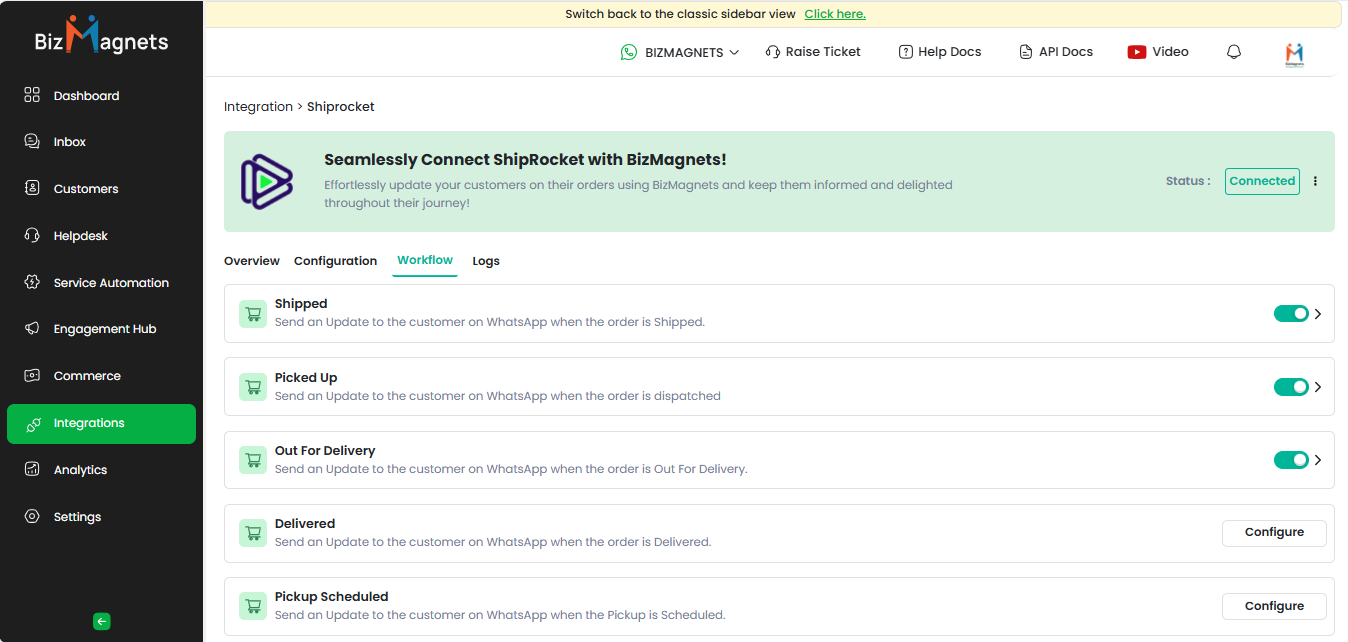
Easily automate notifications by setting up workflows within your ShipRocket integration in BizMagnets. Select a message template and map variables to create a personalized experience for customers.
## **Order Shipped Notifications**
To automatically send order shipped notifications, set up a workflow under ShipRocket Integration with BizMagnets. Here’s how:
1. Go to Integration, select ShipRocket Integration, and choose the desired connection name.
2. Toggle on Order Shipped Workflow.
3. Choose the message template you wish to send when a customer makes a payment to your business.
4. Map the appropriate variables for the template and click Submit.
Your workflow is now ready to keep your customers updated on their shipments!
## **Order Pickup Notifications**
To automatically send notifications when an order is dispatched, set up a workflow under the ShipRocket Integration with BizMagnets. Here’s how:
1. Go to My Integration, select ShipRocket Integration, and choose the connection you want to use.
2. Toggle on the Order Picked Workflow.
3. Select a message template to send to customers upon payment.
4. Map the necessary variables for the message template and click Submit.
Your workflow is now set to keep customers informed when their orders are picked up for delivery!
## **Delivery Update Notifications**
To automatically send "Out for Delivery" notifications, create a workflow under the ShipRocket Integration with BizMagnets. Here’s how:
1. Go to My Integration and select ShipRocket Integration. Choose your preferred connection.
2. Toggle on the Out for Delivery Workflow.
3. Select a message template to notify customers when their order is out for delivery.
4. Map the required variables for the template and click Submit.
## Delivery Success Notifications
To automate notifications for successful deliveries, follow these steps:
1. Go to My Integration and select ShipRocket Integration. Choose the appropriate connection.
2. Toggle on the Delivered Workflow.
3. Choose a message template for delivered orders.
4. Map the relevant variables and click Submit.
## Scheduled Pickup Alerts
For automated notifications when an order is scheduled for pickup, set up a workflow as follows:
1. Go to My Integration, select ShipRocket Integration, and pick the connection you want.
2. Toggle on the Pickup Scheduled Workflow.
3. Choose a message template for scheduled pickups.
4. Map the necessary variables and click Submit.
Each workflow ensures that customers receive timely updates, enhancing their experience with your business.